Finding high-impact opportunities
Start with a signal
Imagine your homepage gets more traffic than any other page on your site. But when you review visitor behavior, you notice that few people scroll past the first section. Your primary call to action sits farther down the page and receives very few clicks.
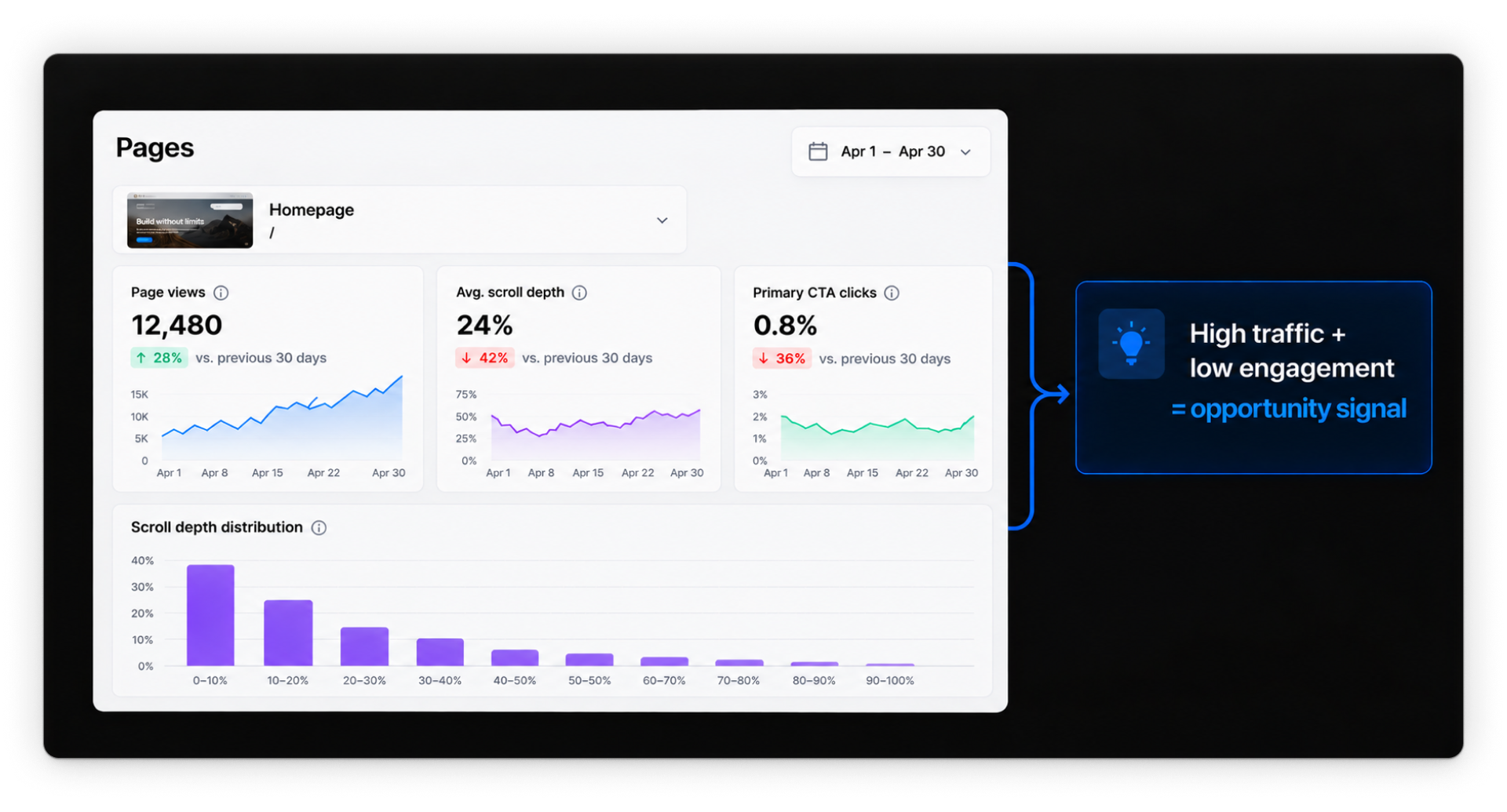
That’s more useful than starting with a hunch like, “Let’s try a green button.” The data points to a specific problem you can investigate.
Look where changes can matter
You don’t have to guess where to look. Your site data can point you toward stronger opportunities.
Start by looking for:
- High-traffic pages: Even a small improvement can affect many visitors.
- High-intent moments: Pricing pages, signup flows, forms, and checkout pages sit close to meaningful conversions.
- High-impact elements: Headlines, hero sections, forms, and primary calls to action can strongly influence what visitors do next.
In our example, the homepage has high traffic and the CTA represents an important next step. That makes it a stronger opportunity than a minor element on a rarely visited page.
Turn the signal into a problem
Your data gives you an observation:
Before deciding why, look a level deeper. Does the behavior change for different groups of visitors?
For example, you may find that mobile visitors click the CTA far less often than desktop visitors.
That gives you a more useful problem statement:
Now you have a specific audience, a specific behavior, and a possible cause you can test.
Form a hypothesis
Turn the problem statement into a prediction using this structure:
Let's apply that to our homepage example:
Each part has a job:
- Change: Move the CTA above the fold
- Expected result: More trial starts from mobile visitors
- Reason: More visitors will see and click the CTA
The expected result also points you toward the goal you’ll use to measure success.
Get clear results
A hypothesis needs a measurable result.
- Too vague: Moving the CTA will improve the page.
- Testable: If we move the CTA above the fold, then more mobile visitors will start a trial, because more visitors will see and click the CTA before they stop scrolling.
Where possible, test one variable at a time. If you change the headline, CTA copy, and layout all at once, you may get a result — but you won’t know which change caused it. A focused change makes the result easier to interpret and gives you a clearer idea of what to test next.
Feed it forward
A good hypothesis does more than set up one optimization. It tells you what you expect to happen, how you’ll measure it, and what you’ll learn from the result.
If the hypothesis is supported, you’ve learned something useful about what influences visitor behavior. If it isn’t, you’ve still learned that your assumption didn’t hold. Either way, that learning can feed directly into your next test.
It also gives you a clear entry for your optimization roadmap: the opportunity, the hypothesis, and the goal you’ll measure.
Ready to continue?
You know how to find an opportunity worth testing and shape it into a hypothesis you can prove or disprove. Continue to the next lesson to turn a set of these ideas into a prioritized optimization roadmap.