Enterprise custom roles
Scale your team with precision and control using custom roles on Enterprise plans. In this video, you’ll learn how Webflow’s Enterprise custom roles help you manage permissions with confidence by tailoring exactly who can publish to production, make design changes, or manage content. We’ll walk through how to create and assign custom roles, and explore real-world examples that show how teams use them to build securely, collaboratively, and at scale.
Video transcript
Enterprise custom roles in Webflow let you define exactly what different team members can do in your Webflow workspace and sites. Instead of being limited to a fixed set of roles like Designer, Editor, or Admin, you can create custom roles with precise permission sets tailored to your organization's needs.
This is particularly valuable for large teams where responsibilities are clearly divided. A content team might need CMS access but shouldn't be touching design. A regional marketing team might need access to a specific locale but not the full site. A contractor might need to publish to staging but not to production. Custom roles let you define all of these scenarios precisely.
To set up custom roles, you work in your Workspace settings under Roles. From there you can create a new role, give it a name, and configure what it has access to — which sites, which publishing environments, which CMS collections, which locales, and more.
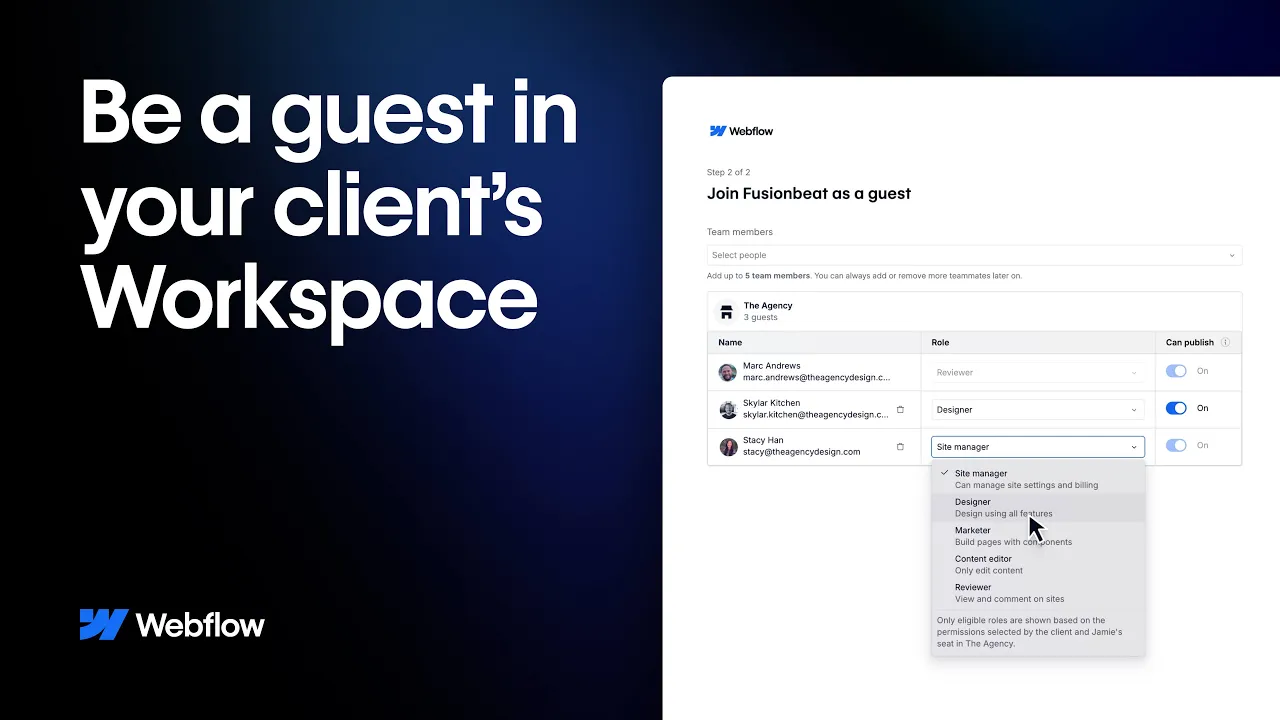
Once a role is created, you can assign it to workspace members or guests. That person's access across all relevant sites is governed by the permissions you've defined in the role.
Custom roles are part of Webflow's broader enterprise governance toolkit, alongside features like page branching, approvals, and audit logs. Together, these tools give enterprise teams confidence that changes to their site go through the right process before reaching a live audience.
.jpg)