The AEO Maturity Model
The Webflow AEO Maturity Model
AEO introduces new ways of thinking about content, structure, authority, and measurement. But you don’t have to tackle everything at once. The Webflow AEO Maturity Model gives you a simple way to understand where your organization is today, what’s already working well, and where your next improvements will make the biggest impact.
This isn’t a score or a ranking. It’s a roadmap that helps you set priorities and take the next right step.
Webflow’s AEO Maturity Model evaluates maturity across the four pillars you learned in the last lesson:
- Content
- Technical foundation
- Authority signals
- Measurement practices
Each pillar evolves over five levels — from early, keyword-driven strategies to advanced, AI-ready, programmatic approaches.
Wherever you land today, your goal is simply to understand what to focus on next, not to “reach Level 5.”
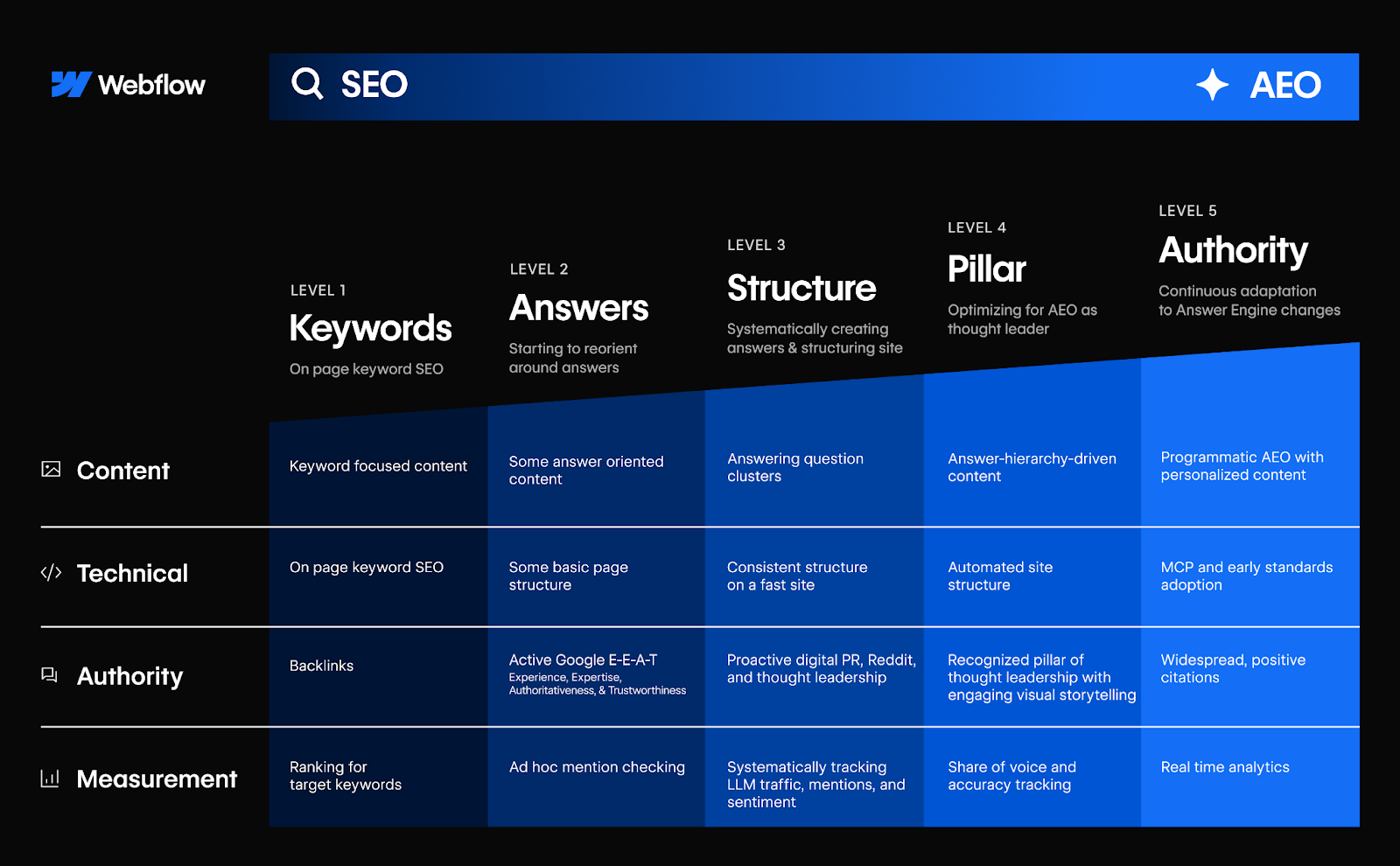
The five maturity levels
Think of the levels as stages of evolution. Each one represents a shift in how content is created, structured, and interpreted by AI systems.
Level 1: Keywords
At this stage, content is primarily built around keywords rather than real questions.
You might be here if your content targets short keyword phrases, structure is inconsistent, and your brand has limited external mentions.
If you’re here, focus on identifying the actual questions your audience asks and start collecting clear and direct answers.
Level 2: Answers
Content begins to address specific prospect questions, rather than just keywords.
You might be here if you’re moving from keyword lists to question clusters, your technical setup supports SEO basics, and you’re starting to see occasional visibility in AI tools.
If you’re here, start creating structured, question-driven content that delivers clear answers on your site.
Level 3: Structure
At this stage, your site is organized so AI systems can reliably interpret meaning.
You might be here if pages use clear headings and semantic structure, schema is applied to some content types, and internal linking reinforces topical relationships.
If you’re here, focus on consistency — expanding structured content across your site and making meaning easy to interpret.
Level 4: Pillar
Your brand starts to be recognized as an authority in your space.
You might be here if your content is cited in industry publications, your thought leadership appears externally, and AI-generated answers frequently reference your site.
If you’re here, focus on creating deeper expertise: original data, in-depth content, and consistent external presence.
Level 5: Authority
This represents highly mature, programmatic AEO practices.
You might be here if your brand appears consistently and accurately across AI tools, content is updated based on measurement insights, and authority signals are strong and widespread.
If you’re here, focus on maintaining clarity, accuracy, and adaptability as search evolves.
Reflection: Where do you think you are today?
The maturity model is most useful when you apply it to your own site.
Rather than answering every question at once, start by reflecting across the four pillars:
Content
- Are we answering real, full questions our customers ask?
- Do we cover entire topics, not just isolated pages?
- Is our content up-to-date and accurate?
Technical
- Is it easy for AI to understand the meaning of our pages?
- Do we use semantic structure and headings consistently?
- Are schema and llms.txt used where relevant?
Authority
- Where does our brand get mentioned online?
- Do those mentions describe us accurately?
- Are we contributing expertise outside our own website?
Measurement
- How do AI systems currently describe our brand?
- Are we tracking AI-sourced traffic?
- What questions would we want AI tools to surface us for?
There’s no perfect place to start. Most organizations move through the model at different speeds across each pillar.
The key question is simple: What’s the one improvement that would make the biggest impact right now?
If you’d like a more complete read on where you stand today, you can take the optional AEO Maturity Assessment for personalized insights and recommendations across all four pillars.
Ready for the next step?
Now that you know your maturity level, let’s explore how to build answer-driven content — content that AI can easily understand, summarize, and cite in responses.